


Volume Norms in iGaming: How to Avoid “Audio Aggression” and Why It’s Now a Compliance Issue
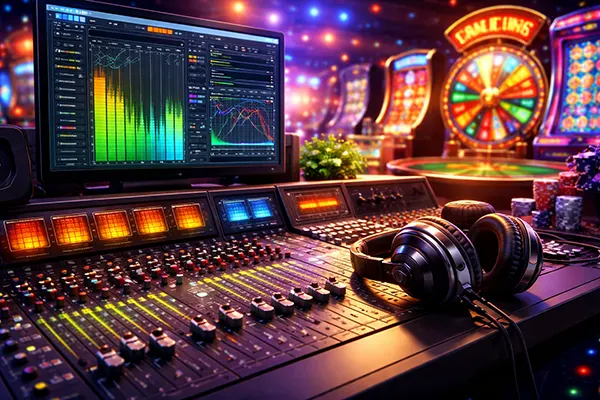
In iGaming, sound is not decoration. It’s feedback, urgency, reward and, sometimes, a hidden stressor. If your win stingers jump out, your alerts pierce, or your in-game promos land louder than the game itself, players notice. They may not know the word “loudness”, but they know the feeling: sensory overload, fatigue, and a fast route to muting everything or closing the session.
The Metrics That Matter: LUFS, True Peak and Loudness Range
Most teams already watch peak meters, yet peaks do not predict perceived loudness. Two sounds can hit the same digital peak and still feel wildly different because one is heavily compressed (high average energy) while the other is dynamic. This is why modern workflows lean on LUFS/LKFS (perceived loudness measured via ITU-R BS.1770) rather than “how close you are to 0 dBFS”. In practice, LUFS helps you compare slots, live tables, UI, and promo audio on the same perceptual scale.
True peak is the second non-negotiable metric. Standard sample peaks can miss inter-sample peaks created by conversion, streaming codecs, or device DACs. True peak (dBTP) catches those overs and reduces distortion risk, especially on mobile speakers and cheap headphones. When you hear “it’s not that loud, it’s just harsh”, true-peak overs and aggressive limiting are frequent culprits.
The third metric is loudness range (LRA), which describes how much loudness varies over time. Games need some dynamics to feel natural, but too much range forces players to ride the volume control. Too little range often means everything is crushed, causing fatigue. LRA is also where “just make it quieter” fails: lowering the master reduces everything, but the jump between a calm base loop and a win hit can remain just as annoying, only quieter.
Why “Just Turn It Down” Fails in Production
Players don’t experience your audio as separate assets; they experience transitions. If the base loop sits around a comfortable loudness but the win sound is mastered hotter, the relative jump is the issue. Turning the whole mix down keeps the jump intact. What you need is relative consistency: predictable loudness relationships between states (idle, spin, anticipation, win, bonus, alert).
Another reason is device variability. Phone speakers roll off low end, headphones exaggerate highs, TVs may apply their own processing, and some operating systems add loudness management. A mix that feels “fine” on studio monitors can feel sharp or cramped on a handset. If you rely on a single overall volume knob, you push the burden onto the user rather than engineering the experience.
Finally, iGaming audio is layered: music, ambience, UI, voice, win stingers, celebratory jingles, plus promotional clips. Without a measurable policy, each vendor or content pack ships with its own loudness habits. The result is a patchwork where one slot feels calm and the next feels like it’s shouting. By 2026, that inconsistency is not only UX debt; it’s a governance problem you can’t explain away after complaints arrive.
Where the Risks Sit: Overload, Complaints and Loudness Jumps
“Audio aggression” is rarely one single sound. It’s accumulation: sharp transients, dense midrange, constant high-energy looping, and repeated reward hits that never breathe. Even when players enjoy the game, the body still processes persistent stimulation. Over longer sessions this can contribute to fatigue, headaches, and a general sense that the experience is “too much”, especially for noise-sensitive users.
On the operational side, inconsistent loudness generates customer support friction. Players report “loud ads”, “annoying jingles”, or “that one game is way louder than the others”. These are not subjective-only issues; they’re often reproducible with metering. If you monetise with in-game promotions or video inserts, mismatched loudness is a predictable trigger for complaints because it breaks the player’s expectation of control.
Regulatory pressure is also moving in a direction that makes audio governance harder to ignore. Loudness rules are established in broadcast (EBU R 128 in Europe; ATSC A/85 tied to CALM in the US), and jurisdictions are already discussing loud ad experiences in streaming contexts. Even when your channel is not classic broadcast, the expectation is converging: ads should not jump above surrounding content, and services should offer accessible controls. In 2026, treating loudness as a documented policy is simply lower risk than treating it as taste.
Slots vs Live vs Promos: Why the Same Game Lobby Can Feel Chaotic
Slots often ship with punchy, forward win stingers designed to be exciting on small speakers. Live games, by contrast, may contain speech, room tone, and more natural dynamics. When these sit side by side in a lobby, switching content types can create perceived loudness shocks, even if both have “reasonable” peaks. Without integrated loudness targets, the player experiences a jump every time they change mode.
Promotional audio is a special hazard because it is typically mastered for impact. If a promo clip is mastered hotter than game content, you create the classic “loud commercial” problem inside your product. Broadcast learned this lesson the hard way, which is why A/85-style thinking exists: ads should match programme loudness, not exceed it. The same principle applies here, even if you’re not legally bound to broadcast rules.
There’s also the psychological mismatch: a near-silent base loop can make a moderate win sound feel explosive. Conversely, constant loud ambience can make everything feel tiring. The fix is not to flatten all dynamics; it is to define relationships and keep them consistent. When you can state, in numbers, how loud each layer is allowed to be and how it is checked, you move from arguments to repeatable production.
A Practical Loudness Checklist for iGaming Teams in 2026
Start with a written loudness policy, even if it’s one page. Choose a reference loudness target for your interactive mix and a tolerance (for example, “integrated loudness for a representative gameplay capture is within ±1 LU of target”, using ITU-R BS.1770 metering). In European teams, −23 LUFS is a familiar anchor because of EBU R 128, while −24 LKFS is common in A/85 workflows. The exact number matters less than consistency across your catalogue, as long as your targets are defensible and measurable.
Set a true-peak ceiling and stick to it across all assets, including short UI sounds. A true-peak cap around −1 dBTP is a widely used safety margin in broadcast-style standards, and it helps reduce codec and device overs. Then define a dynamic philosophy: do you want an energetic but not crushed feel? Put guardrails on loudness range in gameplay captures so you avoid “always-on” density that causes fatigue and avoids “whisper-then-explosion” swings that force users to adjust volume.
Build checks into the pipeline: asset QA (single sounds), mix QA (representative gameplay recordings), and release QA (cross-title comparisons). Do not rely on manual listening alone. Combine listening on a few real devices (phone speaker, mid headphones, TV) with objective checks: integrated loudness, short-term behaviour during wins, and true peak after encoding. This is where you catch the “one vendor shipped everything 4 LU hotter” problem before users do.
Concrete Limits You Can Document and Enforce
Define category-based limits rather than one rule for everything. Example: keep “win stingers” and celebratory jingles controlled in short-term loudness so they don’t leap out of the bed. Treat “alerts” (timeouts, responsible play nudges, confirmations) as usability sounds, not reward sounds, so they should be noticeable but never piercing. The goal is predictable hierarchy: music and ambience support, UI guides, wins reward, alerts inform.
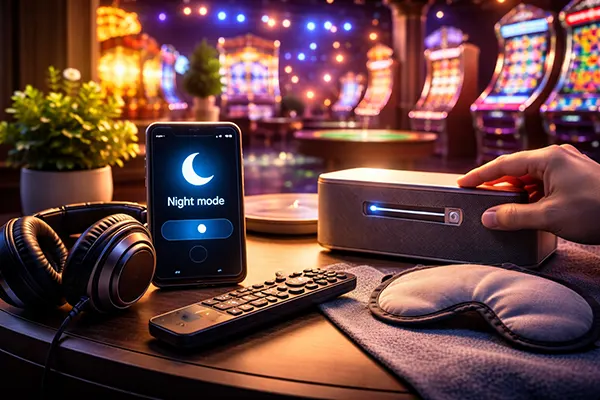
Offer a real “Night Mode” that is more than a simple volume slider. A useful night mode typically reduces dynamic range (so you don’t get surprise jumps), softens aggressive high frequencies, and slightly lowers the relative level of stingers compared with the base mix. Make it persistent per account and easy to find. If you do one accessibility win for audio, this is it, because it helps both noise-sensitive users and anyone playing with others nearby.
Finally, control the loudness of any in-game promotional audio to match the surrounding content rather than exceed it. If you insert video or audio promos, normalise them to your gameplay target and verify true peak after the exact encoding path you ship. Document ownership: who signs off the promo audio, who runs the meter, and what happens when it fails. That turns “please make the ad quieter” into a pass/fail gate you can prove.